Web 2.0 Trends
A comprehensive list of Web 2.0 Sites, Trends, Companies, Services and moreFriday, March 16, 2007
Ajax
It is a web development technique for creating interactive web applications. The intent is to make web pages feel more responsive by exchanging small amounts of data with the server behind the scenes, so that the entire web page does not have to be reloaded each time the user requests a change. This is meant to increase the web page's interactivity, speed, and usability.
Concept
The browser (or client) will load a web page from a web server, and the web page contains Javascript which will be interpreted by the Ajax engine with in the browser.
Labels: Web 2.0 Terms

RSS
- Really Simple Syndication (RSS 2.0)
- Rich Site Summary (RSS 0.91, RSS 1.0)
- RDF Site Summary (RSS 0.9 and 1.0)
Feed representation
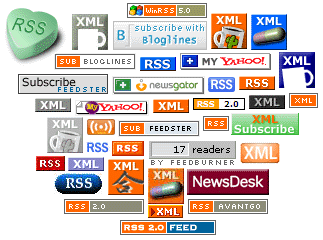
On Web pages, web feeds (RSS or Atom) are typically linked with the word "Subscribe", an orange square, or a rectangle with the letters or . Many news aggregators such as My Yahoo publish subscription buttons for use on Web pages to simplify the process of adding news feeds.


Labels: Web 2.0 Terms
Mashup
- Aggregation of content
- Reusing content
- Mix, Match and Mutate content in various forms
- Making content available for a variety of clients
- Using various APIs (using technologies like Webservices) for content operations
Content is pushed/pulled as web feeds, using technologies like RSS
Some Mashup links
- ProgrammableWeb - John Musser's list of mashups, APIs, and a blog
- Webmashup.com - The Open Directory for Mashups & Web 2.0 APIs
- The Tech Beat: Mash-ups - Blog entries on mashups from Business Week
Labels: Web 2.0 Terms
Web 2.0
Web 2.0 is actually a phrase coined by O'Reilly Media in 2004. As most other definitions, Web 2.0 doesn't have a hard boundary

On September 30, 2005, Tim O'Reilly wrote a piece summarizing the subject. The mind-map pictured above (constructed by Markus Angermeier on November 11, 2005) sums up the memes of Web 2.0, with example-sites and services attached (See the above picture).
What Web 2.0 Means For Users
For users of the web, Web 2.0 means
- Rich user experience
- Aggregation of content in one place (mashup)
- Services that can be easily used
OReilly gives the following concept translation, from Web 1.0 site/concepts to Web 2.0 sites/concepts.
DoubleClick-->Google AdSense
Ofoto-->Flickr
Akamai-->BitTorrent
mp3.com-->Napster
Britannica Online-->Wikipedia
personal websites-->blogging
evite-->upcoming.org and EVDB
domain name speculation-->search engine optimization
page views-->cost per click
screen scraping-->web services
publishing-->participation
content management systems-->wikis
directories (taxonomy)-->tagging ("folksonomy")
stickiness-->syndication
What Web 2.0 Means For Developers
A Web 2.0 website may typically feature a number of the following techniques:
- Rich Internet application techniques, optionally Ajax-based
- CSS (Cascading style sheets)
- Semantically valid XHTML markup and the use of Microformats
- Syndication and aggregation of data in RSS/Atom formats
- Clean and meaningful URLs
- Extensive use of folksonomies (in the form of tags or tagclouds, for example) , and social bookmarking
- Use of wiki software either completely or partially
- Weblog (Blogs) publishing
- Mashups (Aggregation of content)
- Webservice APIs
Labels: Web 2.0 Terms
Archives

Subscribe to Posts [Atom]